01 / RENEWING THE VERY FABRIC OF SOCIETY

From Captivation to Collective Action.

The social fabric is the living network of relationships, trust, knowledge, culture, and cooperation that holds a society together. It's how people find one another, share what they know, organize what they do, and build a common life.

Social media connected billions of people by reorganizing those connections around a market for attention.

Facebook, Instagram, LinkedIn, YouTube, and other platforms use powerful algorithms to determine what we see, what spreads, and who gets heard. Every click, pause, like, comment, and share teaches the algorithms what captures our attention and keeps us coming back.

The infinite scroll, autoplay, recommendation engines, and notifications ensure that the more time we spend engaged, the more advertising can be sold, the more data can be collected, the more valuable the platforms become, the more time we spend engaged in an ever more compelling cycle of addiction.

But what captures attention isn't what deserves it.

Outrage outperforms understanding. Fear, anger, envy, and conflict are more compelling than cooperation. Sensationalism competes with truth. Disinformation spreads, social comparison breeds anxiety, and polarization intensifies.

At its worst, these systems can amplify hatred, disinformation, and violence. In Myanmar, Facebook helped spread anti-Rohingya propaganda during a genocide. In India, viral WhatsApp rumors fueled deadly mob attacks. In the United States, election disinformation spread across social platforms, helping mobilize the January 6 attack on the Capitol. And around the world, algorithmic amplification has helped turn conspiracy theories, political extremism, and manufactured outrage into mass movements of violence and hatred.

The same networks that connect us can also divide us, manipulate us, and turn us against one another.

And the extraordinary value created by billions of people—their relationships, creativity, knowledge, words, images, videos, and attention—is controlled by a handful of corporations whose shareholders extract the value and govern their economics.

The problem stems from an underlying system of algorithms, incentives, ownership, and power.

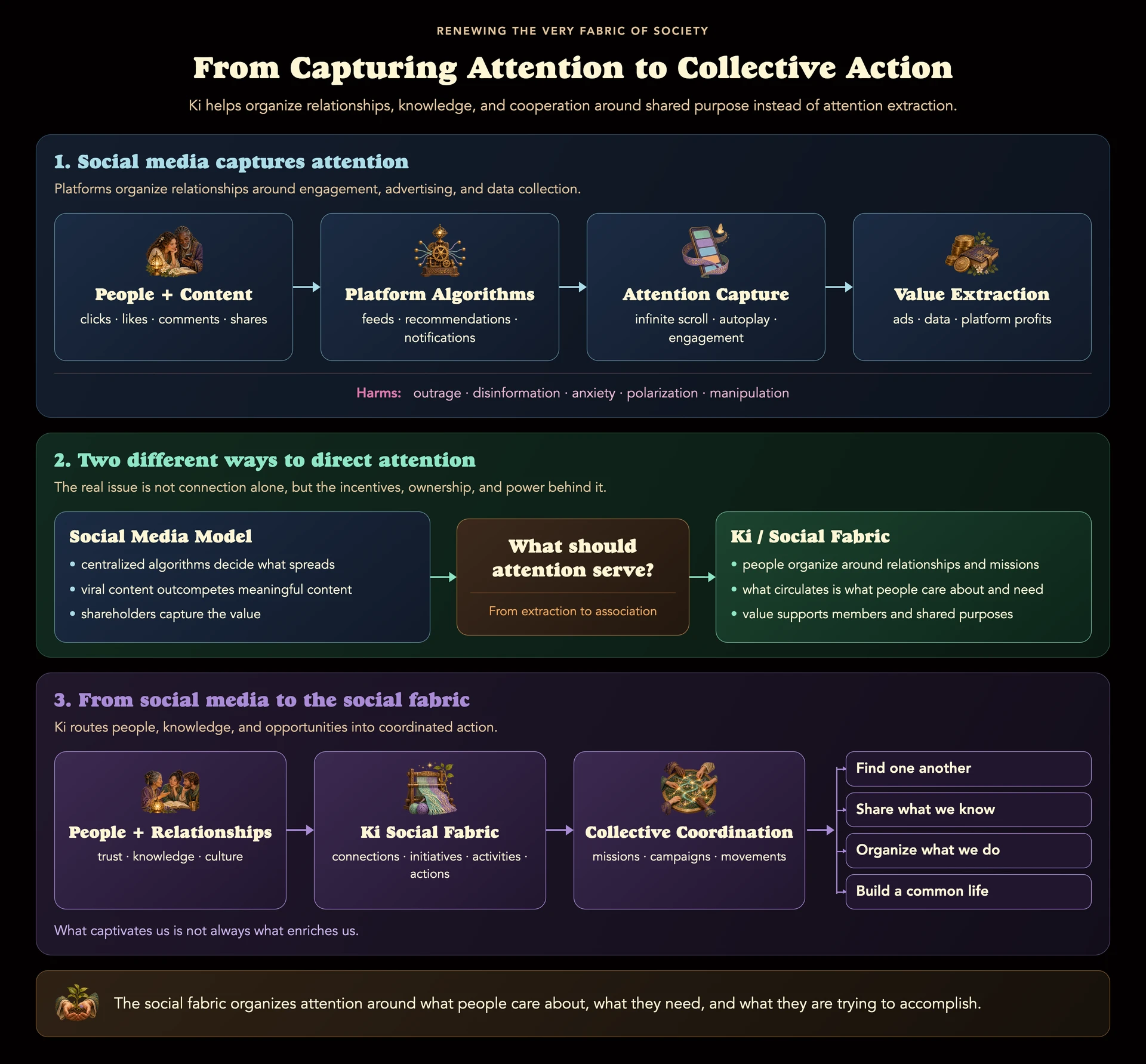
Simply put, social media organizes our relationships to capture attention and extract value.

From social media to the social fabric.

Social media organizes people around content to consume and attention to harvest. Ki’s social fabric helps people organize themselves around the lives they want to lead, the missions they want to pursue, the people they want to associate with, and the world they want to create.

Rather than centralized algorithms routing content and advertising to the most receptive eyeballs, Ki forms a living field of relationships, initiatives, activities, and actions—connecting people with opportunities to advance missions, launch campaigns, and build movements.

Instead of amplifying what’s trending, what's viral, or what advertisers want us to see, Ki circulates what people care about, what they know, what they need, and what they're trying to accomplish.

It's a fundamentally different way of directing attention—from what captivates us to what enriches, enlivens, illuminates, and moves us.

From Capturing Attention to Collective Action: social platforms route people and content toward attention capture and value extraction. Ki’s social fabric organizes relationships, knowledge, and shared purpose into collective coordination: find one another, share what we know, organize what we do, and build a common life.

02 / A LIVING NETWORK OF INTELLIGENCE

Put Your Good Where It Does the Most Good.

Unlike personal agents that serve a single user, Ki connects and coordinates intelligent Allies shaped by the interests, aspirations, capabilities, challenges, and responsibilities of the people and organizations they represent.

Drawing on their Wisdom, Instructions, Skills, Tools, Automations, and Vibes, these Allies communicate across the network—exchanging information, discovering opportunities, matching needs with capabilities, and mobilizing people and resources for coordinated action.

Members don't need to arrive with connections, resources, or ready-made solutions. They don't need to know who has the expertise, which tools already exist, or where to find willing collaborators. Their Allies discover possibilities they could never find on their own, bringing together knowledge, relationships, and capabilities that would otherwise remain scattered and out of reach.

What begins as one person's vision for a better way can grow into a shared initiative, a coordinated campaign, or a movement that changes the world.

Ki's intelligence emerges from the relationships among its participants, not from a central authority deciding what people should want, believe, pay attention to, or act on.

Social media operates on a different logic. Every click, tap, pause, and scroll feeds algorithms designed to capture attention and maximize profit. These algorithms continually shape our perception of the world, amplifying whatever keeps us engaged—even when that means more fear, outrage, division, and distrust. The result is a self-reinforcing cycle that directs our collective attention toward what provokes us rather than what brings us together.

Ki reverses that logic. Rather than directing attention toward what generates the most engagement, Ki routes intelligence and resources toward what advances shared purposes, produces meaningful results, and creates positive change.

Ki doesn't decide what matters. People do. Ki helps them discover common ground, combine their capabilities, and accomplish together what nobody could achieve on their own.

03 / WHERE CULTURE IS CREATED, NOT IMPOSED

Culture is what we do together.

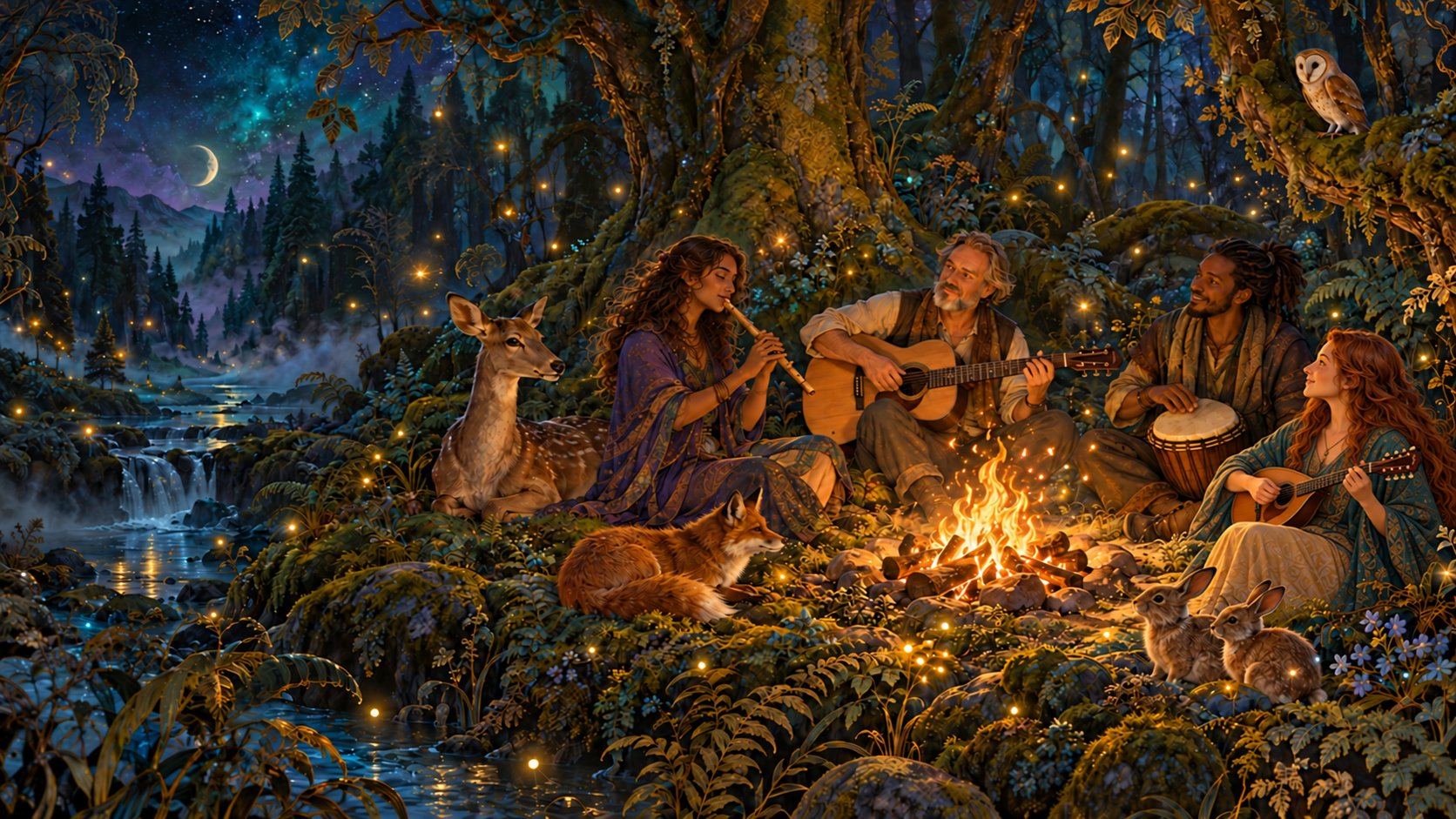
People making music together beside a woodland fire, surrounded by animals, trees, stars, and a moonlit river.

For most of humanity's 300,000-year history, culture was something people created and shared through stories, songs, rituals, myths, and oral traditions.

These weren't simply entertainment. They carried collective wisdom, connected people to nature and one another, mapped the frontiers of the heart and soul, and gave expression to the deepest currents of the human imagination. They evolved through retelling and adapted to changing circumstances as they guided communities finding their bearings in an ever-evolving, living world.

Culture wasn't something people consumed. It was something they lived, co-created, and continually renewed together.

Then came writing.

One of humanity's earliest surviving great epics, The Epic of Gilgamesh, tells of a powerful king confronting the wild, the limits of his authority, and the inevitability of death. Its tensions—between civilization and nature, domination and relationship, individual power and the larger order of life—would echo across generations and millennia.

Writing made it possible to preserve and transmit knowledge while also making it possible to codify, control, and impose culture from above.

Over centuries, scribes, religious institutions, royal courts, publishers, and eventually mass media acquired extraordinary power over what was recorded, reproduced, and distributed.

The printing press multiplied the reach of ideas. Industrial technology multiplied it again. From Tin Pan Alley to Hollywood and beyond, record labels, movie studios, publishing houses, radio networks, and television broadcasters shaped what entire populations saw, heard, read, and believed.

Culture became an industry. Audiences became consumers. Distribution became power.

Then the internet promised to change everything.

Anyone could create, publish, and promote their work around the world. Social media transformed billions of consumers into creators, collapsing the distinction between producing and consuming culture online.

But the gatekeepers didn't disappear. They transformed. Today we know them as the algorithms.

You no longer needed a publisher, studio, or record label to reach an audience. Instead, you had to please the algorithms. Follow the trends. Master the formats. Feed the machine.

The promise of boundless creative freedom gave rise to new pressures for conformity, rewarding imitation, optimizing engagement, and turning human expression into an endless stream of posts, likes, memes, and comments.

Anyone can create. But only a handful of platforms control what gets seen, who gets paid, and what breaks through.

Now artificial intelligence threatens to take this process to an entirely new level.

Imagine the accumulated creative inheritance of humanity—our stories, images, music, knowledge, traditions, and ideas—absorbed into machines capable of reproducing and recombining it at virtually unlimited scale.

AI threatens to become the ultimate engine of cultural conformity: commoditizing our collective imagination, flooding the world with synthetic content, and concentrating even more power in the institutions that control the technology.

But what if we turned that power around?

What if AI didn't just create more content for us to consume, but gave us the capacity to build the world for ourselves?

Guiding and shaping our own intelligent agents. Our own organizations, businesses, studios, publishers, festivals, communities, and institutions. Our own infrastructure for creating, producing, distributing, organizing, and governing.

Not merely competing for attention on platforms owned by somebody else, but owning the means of creation and production, sharing the rewards, and taking back the power concentrated by Big Tech.

That's the promise of Kiduna.

A living social fabric where people can find one another, combine their imagination, creativity, talents, and resources, and turn their aspirations into collective action.

Because culture isn't simply the music we hear, the movies we watch, the stories we read, or the content we share.

Culture is what we create together.

It's our relationships, experiences, knowledge, work, celebrations, struggles, discoveries, and accomplishments. The enterprises we build, the communities we organize, the traditions we invent, and the possibilities we bring into existence.

It's not just what we make. It's how we live.

And here's the surprising part: reclaiming that power isn't a sacrifice. It isn't about giving up entertainment, pleasure, individuality, or fun for some abstract greater good.

It's about discovering how much more exciting life becomes when we're shaping the world around us instead of merely consuming what we’re given.

The thrill of making something real. The excitement of discovering unexpected allies. The joy of building something that belongs to us. The freedom to experiment, reinvent, and change the rules instead of merely playing by them.

Individual achievement and collective good aren't competing objectives. They amplify one another. Our lives become richer through what we create together, and our collective possibilities expand through the imagination, initiative, and individuality of every participant.

This is about power. Not just the power to express ourselves, but the power to create, organize, build, own, govern, and change the world we inhabit.

The social fabric isn't another medium for distributing culture. It's the living foundation from which all culture emerges.

For most of human history, culture was something we made together. The technologies of mass distribution increasingly turned it into something made for us, managed by institutions, and sold back to us.

Now we have an extraordinary opportunity to reclaim that creative power—not by returning to the past, but by putting the most powerful technologies ever invented in our own hands.

We’re not striving for a bigger voice in the world as it is. We’re reclaiming the power to make the world our own.

Find your people. Pool your power. Make your mark.

Get the App